

BathAware: safety without surveillance
University
Awards category


share

For many older Australians, a fall in the bathroom can have seriousconsequences. But monitoring people in one of the most private spaces in theirlives raises an important question: how can we improve safety withoutsacrificing dignity and privacy?
BathAware, developed at The University of Western Australia, offers anew answer. Using smart environmental sensors and artificial intelligence, thesystem can identify potential falls and alert carers without relying oncameras, microphones or wearable devices.
Designed for aged care, home care and independent living settings, thetechnology acts as a passive safety net, helping ensure incidents do not gounnoticed while protecting personal privacy.
The system has achieved 96 per cent accuracy in testing and is now beingtrialled with aged-care providers and households across Western Australia.
By putting privacy at the centre of innovation,BathAware is helping older Australians live safer, more independent lives.
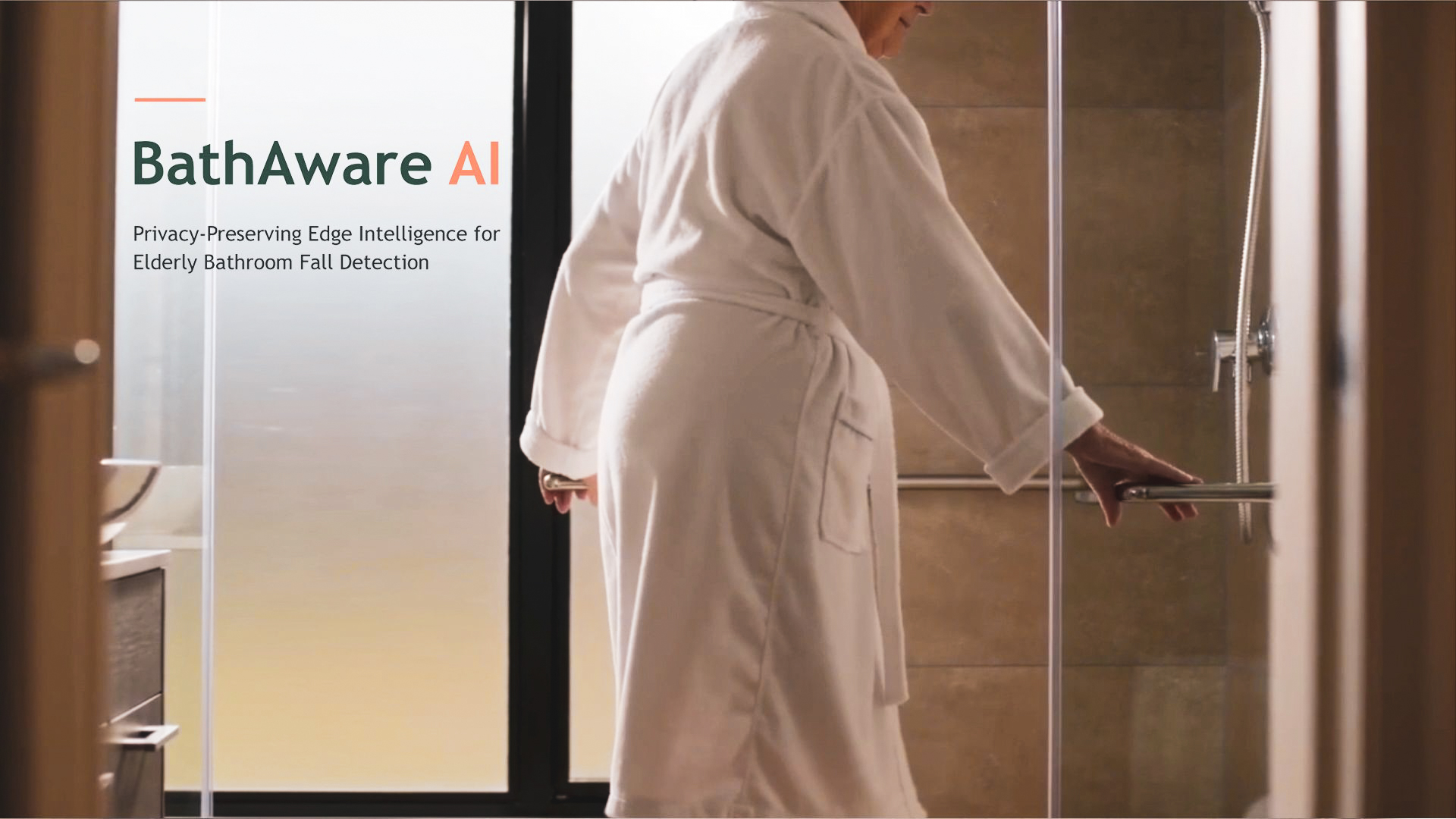
BathAware is designed around a simple principle: older Australians should not have to choose between personal safety and privacy in the spaces where dignity matters most.
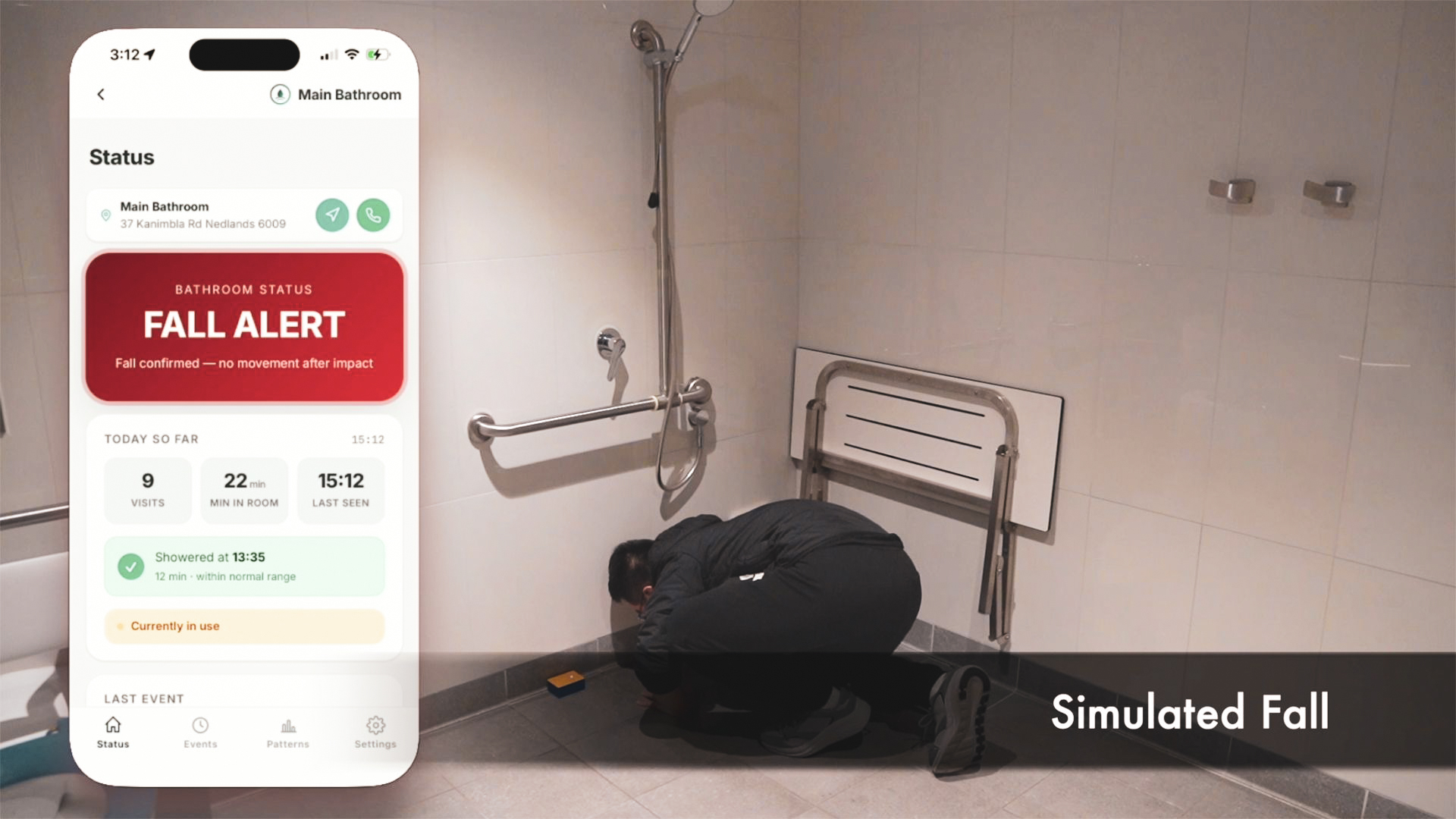
A bathroom fall triggers a real-time BathAware alert, showing how ambient sensing becomes actionable caregiver information without cameras, microphones or wearables.
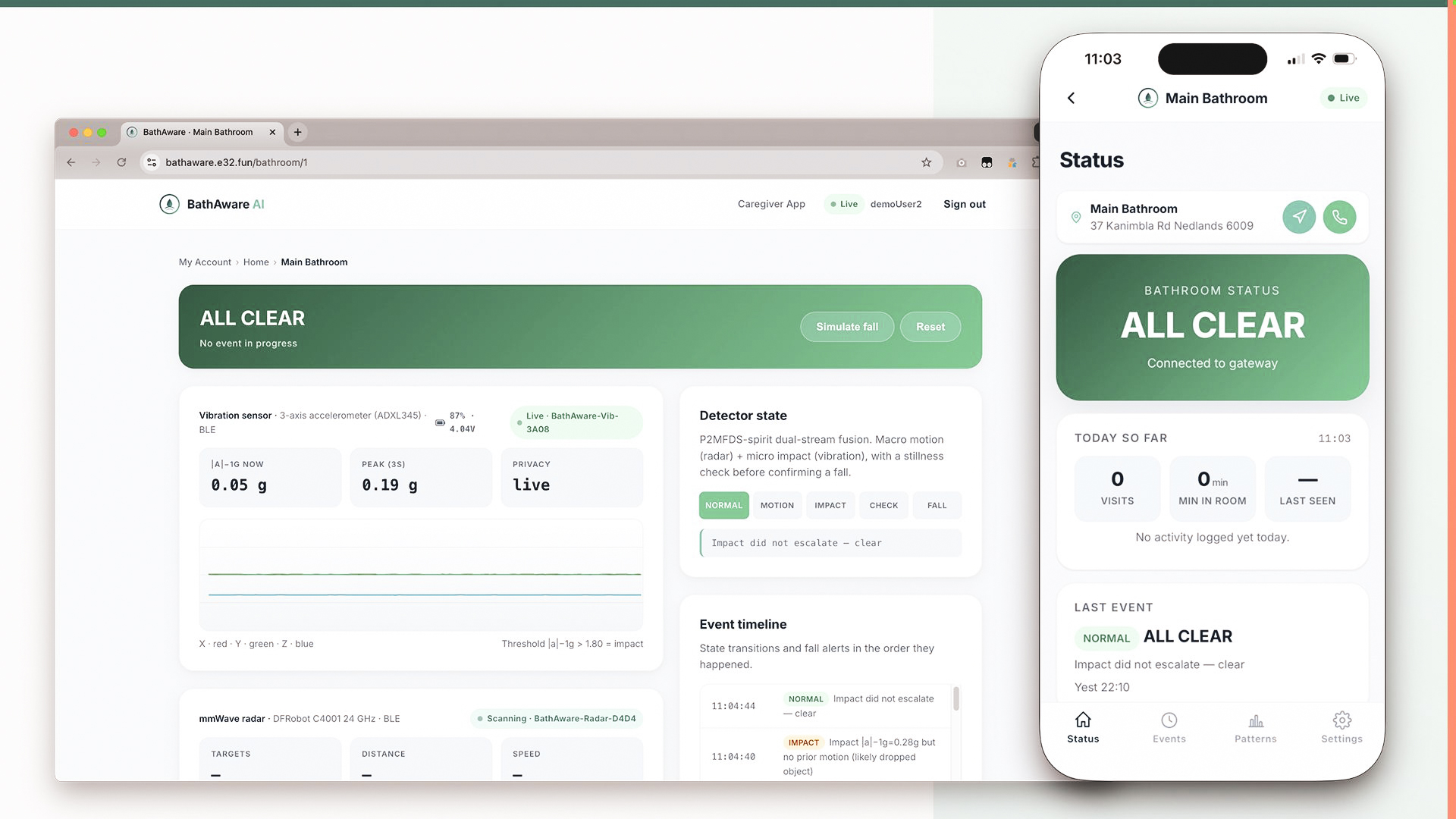
BathAware’s caregiver interface brings local sensing, event verification and alerts into one operational view for residential care and ageing at home.
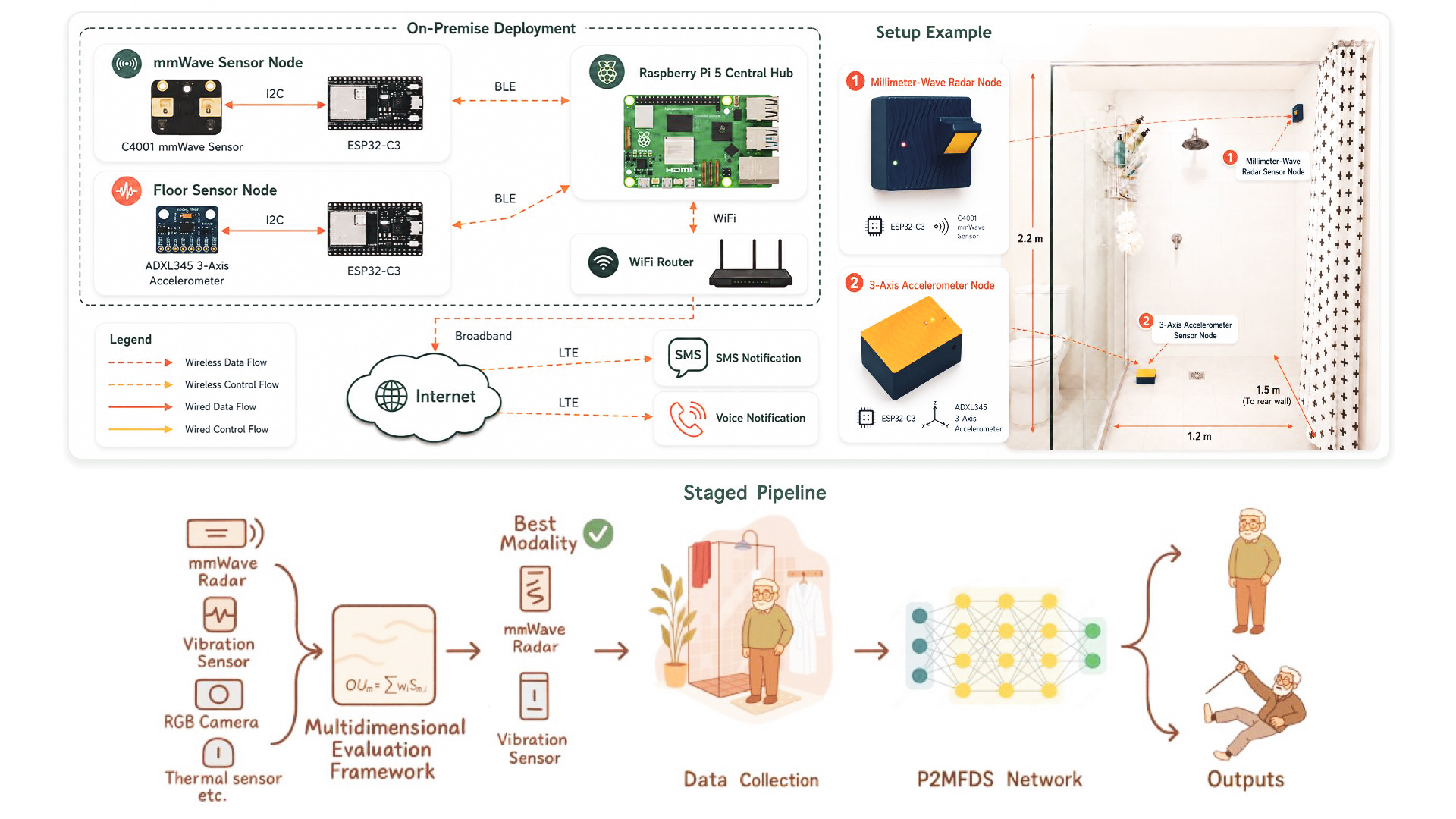
BathAware integrates non-visual sensing, local edge intelligence and caregiver notification in one deployable platform, connecting room-level awareness with care response.
BathAware supports safer ageing in one of the most private and high-risk spaces in the home, combining passive safety awareness with privacy, dignity and independence.
Bolgart Aged Persons Units has provided a practical regional setting for the field evaluation of BathAware. The project addresses an important challenge for aged-person accommodation: how to improve awareness of serious bathroom incidents without introducing intrusive monitoring or creating additional tasks for residents.
Our engagement progressed beyond an initial discussion into site-based evaluation. The BathAware team assessed the environment, installed and configured the sensing and edge hardware, conducted supervised fall and non-fall testing, reviewed system behaviour and adjusted the deployment to local conditions. This allowed us to consider the complete product, including installation, privacy, connectivity, alert presentation and the practical requirements for ongoing operation.
The regional context makes these issues particularly relevant. Any technology intended for small aged-person accommodation must be straightforward to deploy, require limited local technical support and fit around existing operations. BathAware's passive, non-visual approach is well aligned with those requirements.
The field work also created a useful feedback loop. Practical observations from the site were taken back into product configuration and deployment procedures rather than treated as a one-off demonstration. Our discussions have also extended to the potential for continued and future commercial deployment following the current validation process. I support BathAware's nomination as a credible example of university research being translated into a deployable safety platform for older Australians.
Colin Ashe - Deputy Chief Executive Officer, Shire of Victoria Plains - Bolgart Aged Persons Units
BathAware was installed and tested in my home as part of its real-world evaluation. I was interested in the system because bathroom safety is important, but so are privacy, independence and the ability to live normally without feeling monitored.
The system did not require me to wear, charge or remember to activate a device, and it did not rely on visual or audio monitoring. Instead, it worked quietly in the background and used local processing to identify a potentially serious event and provide the information needed for response. This allowed me to see how the product would operate in an ordinary home rather than only in a laboratory setting.
During the testing, the team reviewed installation, connectivity, alerts and day-to-day usability. They listened carefully to feedback about device placement, privacy controls, how information should be presented and how the system should fit around normal routines. Changes were made as the testing progressed.
For me, the value of BathAware is not simply fall detection. It is an additional safety layer that can support an older person while preserving privacy and independence. Following the testing, I expressed my intention to continue working with the team and to purchase the system as it progresses into broader deployment. I support BathAware's nomination because it addresses a real need in a way that respects how people want to live at home.
Mia Cheng - Private-home testing participant and prospective customer
I have led and supervised the UWA research program that underpins BathAware from its early research formulation through to prototype development and technical validation. My role has covered the non-commercial research and development of the project, including research direction, experimental design, sensing strategy, system architecture, prototype design, technical evaluation and the progression of the work into a field-ready system.
The project began with a clear research challenge: how to identify serious bathroom incidents without relying on intrusive monitoring or devices that an older person must remember to wear or activate. Under this program, the team systematically evaluated sensing options, developed dedicated multimodalbathroom data resources, designed new methods for combining motion and impact evidence, and implemented edge-efficient inference for local deployment. This work has produced peer-reviewed publications, reusable research outputs, an integrated working prototype and intellectual property protection through Australian provisional patent application 2026905496.
A key strength of BathAware is that the research has not remained at the level of a model laboratory demonstration. The technical work has been translated into a complete ambient care system that combines sensing, local intelligence, event verification, privacy controls, caregiver alerting and deployment workflow. The prototype has subsequently been installed and tested real aged-care and residential environments, allowing field observations to inform further technical refinement.
I support its nomination for the Shaping Australia Awards as an example of UWA research progressing from methodological innovation and prototype development into a practical privacy preserving safety platform for older Australians.
Sheldon Fung - Research Fellow, The University of Western Australia
BathAware: safety without surveillance | The University of Western Australia
Stay informed
Receive the latest updates about the Shaping Australia Awards program.